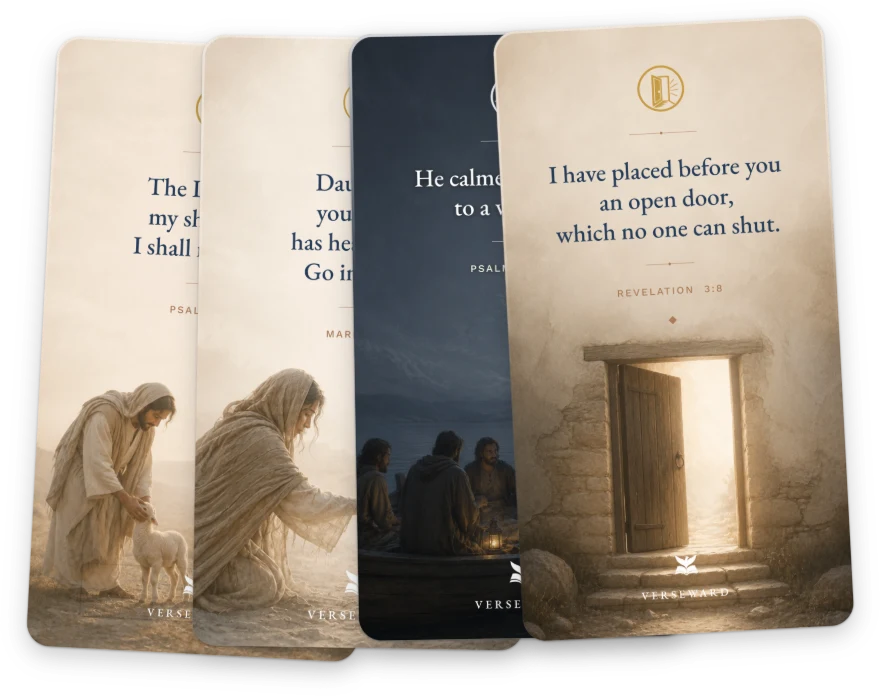

If part of you is pacing the room wondering whether you're being guided or just spiraling — whether a real Christian should be this unsure — you can stop wondering.
God's guidance was never meant to feel like a test you might fail. His voice has a specific fingerprint, and once you know what to listen for, you can usually tell.

How do you make space to hear Him at all?
You won't catch a whisper in a room full of noise. Elijah heard God only after the wind, the earthquake, and the fire had passed.
Making space doesn't mean striving. It's a few unglamorous habits: getting quiet on purpose, staying in Scripture even when it feels dry, and praying honestly instead of performing. God isn't hiding from you. He tends to speak most clearly once the noise dies down.

Is this God, or is it my own anxiety?
Start with the pace. Fear drives you with a whip. The Holy Spirit leads you like a shepherd.
A thought coming from your own anxious mind feels frantic and loud. It says, "You have to decide right now, tonight, or your whole life is ruined." It runs on scarcity and panic.
Look at how God spoke to Elijah. He was burned out, hiding on a mountain, when a wind tore the rocks apart — then an earthquake — then a fire.
“But the LORD was not in the wind... not in the earthquake... not in the fire. And after the fire came a still, small voice.”
— 1 Kings 19:11–12
God's voice brings a steady, grounded clarity. Even when He asks you to do something bold, it doesn't corner you. It settles your nervous system instead of hijacking it.
If a thought is pushing you into a frenzy, that pressure didn't come from heaven. Take a breath, and give it a day.

Would God really ask me to do the hard thing?
The second test is motive — where the thought points you.
Your own thoughts, dressed up as God's voice, almost always point toward the easy way out: the path where your ego stays safe and nothing uncomfortable is asked of you.
God's guidance tends to run the other direction. It points toward the humbler road — forgiving when it's hard, trusting Him with an outcome you can't control.
And there's one line His voice will never cross. It will never tell you something that contradicts what He has already written down.
“Your word is a lamp to my feet and a light to my path.”
— Psalm 119:105
If what you're hearing pulls against Scripture, it isn't Him — no matter how spiritual it sounds. Checking it against God's Word is the surest defense against fooling yourself.

How do I know if I actually heard right?
The last test is the fruit — what the thought leaves behind after the dust settles.
“By their fruit you will recognize them.”
— Matthew 7:16
An idea from your own overactive mind gives you a spike of adrenaline. You feel certain for five minutes. Then the excitement drains out and leaves doubt, emptiness, second-guessing.
A direction that's actually from God can still be frightening — He might be asking you to leave something, or step into the unknown. But underneath the fear there's a settling. A quiet that stays.
“And the peace of God, which surpasses all understanding, will guard your hearts and your minds in Christ Jesus.”
— Philippians 4:7
He doesn't promise the circumstances get easy. He promises your soul can be at rest inside them.
And if you're still not sure — that's allowed. When a sheep can't make out the shepherd's call, he doesn't get punished for being slow. The shepherd just walks closer.

A few things you can do, not just one:
Run it past Scripture first. God will not tell you something that contradicts what He has already written. If you're not sure where to look, that's what Verseward is for.
Slow the clock down. If the thought demands you move "right now, or else," treat that urgency as a red flag, not a green light. Sit with it for a day and see if it still feels the same.
Watch what it leaves behind. Adrenaline that fades into doubt is one signal. A quiet that stays even when the decision is hard is another.